Losing
their Religion? ...continued
I wondered
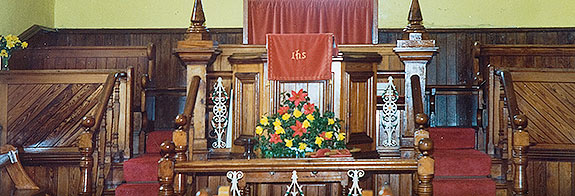
why the folk of Ponsongath warranted having their own place
of worship and rummaging through the archives, I read that those good
souls worshipped a religion quite different from any I have previously
encountered. Don't worry, they didn't practise black arts or anything
weird.... if they did, they kept quiet about it, although it may have
its innate spirituality from an older time. The chapel was built in
1829 and the minister wrote ' a newly built chapel by united efforts
of preachers and people. Friends in the neighbourhood are generally
poor but it was begun in hope, carried on in faith and finished in
charity'. The original walls were stone and cob, with a thatched roof
and the floor lime and sand. However, earlier, in 1824, an Alice Rule,
from Arrowan, open her home for worship. Alice, nee Harris, was a local
girl, married William Rule, had ten children and was a Bible Christian.
I hadn't heard of Bible Christians. Research
revealed that they were a breakaway evangelical denomination of mainstream
Weslyan Methodists. In 1815, the year Napoleon was defeated at Waterloo,
William O'Bryan from Luxulyan, a radical evangelist, began the Bible
Christian church in a farmhouse in Shebbear. He wasn't permitted to preach
in the Methodist church due to his 'indiscipline' and irregularity' ,
he went beyond the boundary of his circuit into the wild wasteland of
Cornwall, preaching in fields, on village greens and in his followers'
homes. What amazed me, is that he encouraged women as equals, including
his wife, to address the congregation directly. He would have known that
the scriptures had no place for woman as preachers, but he felt God blessed
this and his wife, Catherine, became his first female preacher. It's
understandable that he annoyed traditionalists as this quote from Corinthians
is a tenet frequently used to replace reason, "As in all the congregations
of the saints, women should remain silent in the churches. They are not
allowed to speak, but must be in submission, as the Law says. If they
want to inquire about something, they should ask their own husbands at
home; for it is disgraceful for a woman to speak in the church'....mmm.
no comment.!
Of course, this didn't last, as the years
rolled under the restraints of the Victorian era, emancipated thought
was throttled... women in an assertive position of power and influence
...tut, tut... scandalous... but I will hazard the musings of a lifelong
pantheist. Contemplate the sacred feminine of Celtic spirituality. William
O'Bryan was a Cornishman from Irish descent, who was taught to pray by
his mother - maybe, suggesting the influence of the priestess as the
keeper of custom and belief? Perhaps there was some vestige of pagan
spiritualism shading his Christian beliefs. Living in remote places,
close to the pulses of the natural year, age old traditions associated
with birth, death and healing are compatible with the feminine wisdom
of women who were revered and not feared.
O'Bryan's converts, known as Free Willers
and Shining Lights, found fertile ground amongst country people seeking
salvation. My impression is that the movement was hugely successful;
it provided more than redemption and brought communities together for
fun and games and a lively break from the drudgery of a hard life. The
Bible Christian Tea Treat, as a celebration of a summer feast day, still
lingers on in Ponsongath with a 5 a-side football match and BBQ. Coverack
had two small chapels, one of which had a congregation of over 60 and
is now a pretty, thatched cottage; a holiday home, called the Little
Ship. The class register noted that there were 'backsliders and wanderers'
who were removed from the list and if the role call was anything to go
by, the recalcitrants were 'downsers' from out on the moor - Exelbys,
Iveys, Rules, Pengellys, and Gays, all of whom lived around Ponsongath!
Yes, it will be sad if any chapel
closes its doors, but does it really matter? It's a building dedicated
for prayer, but a building doesn't stop prayer or the congregation keeping
its faith. I like the thought of a belief without the excesses of churches,
opulent with gaudy paraphernalia and elaborate services with iconography
and incence. Those simple country people who worshipped in their own
homes or in a field with the sky above, were just as near
to their God.
 Email
this page to a friend Email
this page to a friend
|